

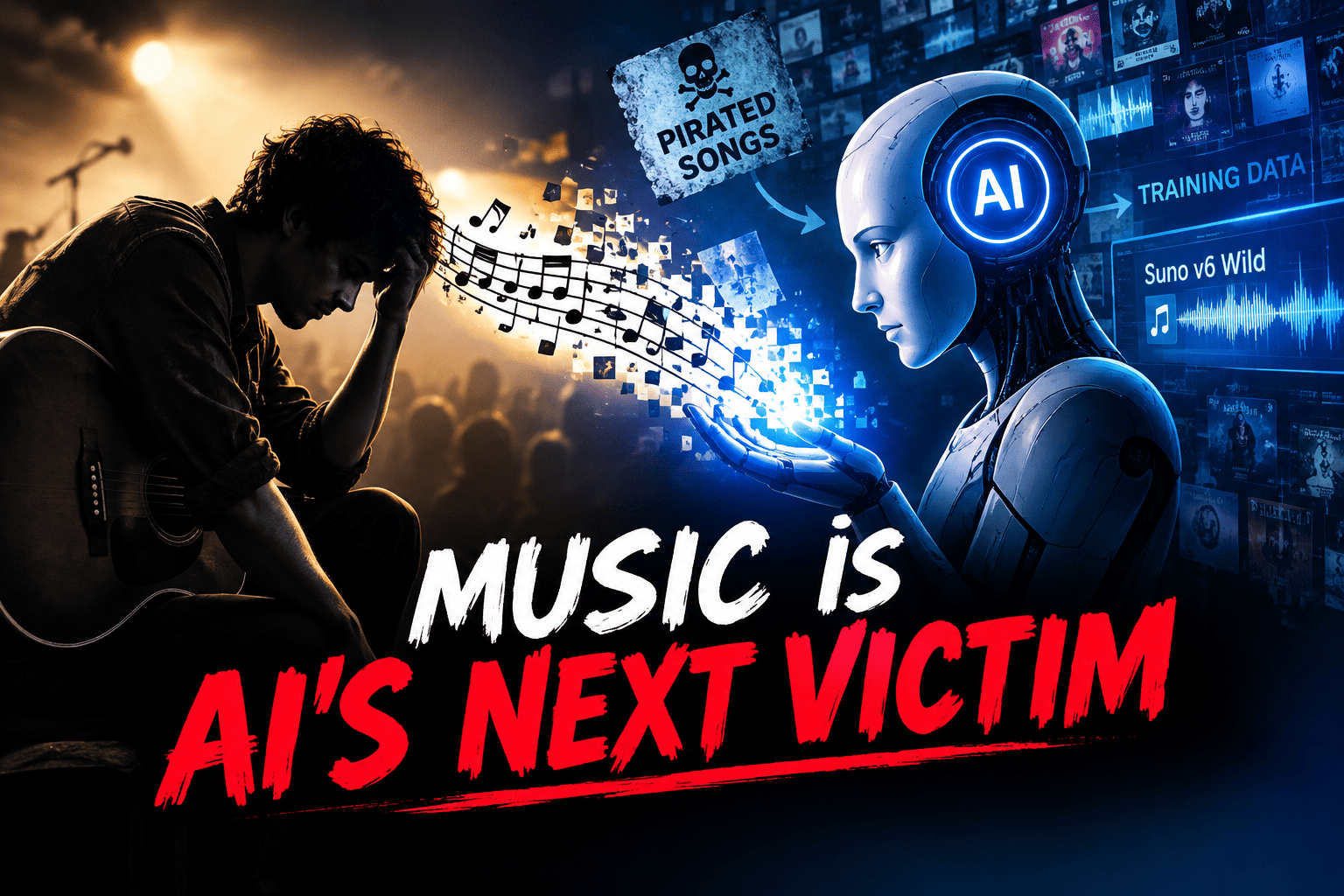
AI is slowly taking over almost every part of our lives. It writes, makes pictures, creates videos, answers questions, builds software, and now it is moving deeper into music. Music may be the next major area where human creativity faces a serious threat. What makes this change more worrying is that some AI music systems may be trained using huge amounts of music that artists never agreed to share, including songs that were copied and distributed through piracy.
Systems such as Suno v6 Wild represent the direction in which AI music is moving. AI can now create songs in seconds from a simple text request. A person does not need to know how to sing, play an instrument, write lyrics, or produce a recording. The machine can do much of the work. This may look exciting, but behind this progress is a difficult question. Where did the music knowledge inside these systems come from, and did the people who created that music give permission for their work to be used?
Music made by people carries years of work, practice, emotion, and personal experience. A singer may spend years developing a voice. A songwriter may spend months writing one song. A producer may spend countless hours creating a sound. When AI systems learn from large collections of existing music, they are learning from the work of these people. If copyrighted songs are copied without permission and used as training material, musicians may lose control over the very work that helped build these new systems.
Read More: Google’s Bard AI Unleashes Enhanced Capabilities with Gemini Pro Integration
The use of pirated music makes the problem even more serious. Piracy already takes money and control away from musicians. If those same illegally copied songs are then collected and used to train AI, the harm can happen again in another form. The artist may first lose income because the song was shared without permission, and then face competition from an AI system that learned from music created by real people. This creates a painful situation where human creativity can become the raw material for a machine that may later compete against the humans who created it.
The biggest threat is not that AI will suddenly destroy music. The bigger threat is that music may slowly become less dependent on musicians. Companies may decide that it is cheaper and faster to create music with AI than to hire singers, songwriters, composers, and producers. Advertising companies could generate background music instantly. Video creators could make their own songs without paying artists. Streaming platforms could fill millions of hours with machine made music. Even businesses that once depended on human musicians may begin to ask why they should pay people when a machine can produce something similar in seconds.
This could make it harder for new musicians to build a career. A young artist needs opportunities to be heard, paid, and discovered. If online platforms become filled with endless amounts of AI music, real musicians may struggle to get attention. The internet could become a place where millions of machine made songs compete with the work of people who have spent their lives learning their craft.
There is also a deeper problem. Music is not only sound. It is human experience. People write songs about love, loss, family, fear, happiness, loneliness, politics, memories, and dreams. A machine can study patterns in music and produce something that sounds emotional, but it does not live the life behind those emotions. When we allow machines to replace too much human creativity, we risk turning art into something that is produced simply because it is fast and cheap.
AI itself is not necessarily the enemy. It can be a useful tool for musicians. It can help with ideas, recording, editing, and production. The real problem begins when technology is built by taking creative work without fair permission, fair payment, or respect for the people who made it. Musicians should not have to choose between accepting AI systems that use their work and watching their careers become harder.
The music industry now faces a choice. It can allow AI companies to collect almost everything they can find and turn human music into training material, or it can demand clear rules about permission, ownership, payment, and transparency. Artists should have a real say in whether their music is used to train AI. If their work creates value for an AI company, they should have a fair way to benefit from that value.
AI is taking over more areas of life because it is fast, cheap, and easy to scale. Music is now standing in its path. If society does nothing, music could become another field where human workers are slowly pushed aside by machines. The danger is not only losing jobs. It is losing the idea that human creativity deserves protection.
Music should not become the next victim of an AI race where companies compete to build bigger systems while ignoring the people whose work made those systems possible. Technology should serve musicians, not quietly replace them. If the future of music is going to include AI, then it must also include consent, fairness, payment, and respect for human creativity.
 Farhan Butt